


Australia’s housing story is showing an important shift: more homes are being approved, but approvals alone do not guarantee that those homes will reach completion.
More Homes Are Being Approved — So Why Does Australia Still Have a Housing Shortage?
Australia’s housing story is showing an important shift: more homes are being approved, but approvals alone do not guarantee that those homes will reach completion.
Australia’s housing pipeline has improved from its recent lows. However, the country still needs a stronger and more consistent flow from approval → construction → completion to meaningfully expand housing supply.
That distinction is at the heart of Australia’s ongoing housing challenge — and it also highlights where the biggest opportunities for improvement now sit.
A Stronger Pipeline Is Emerging
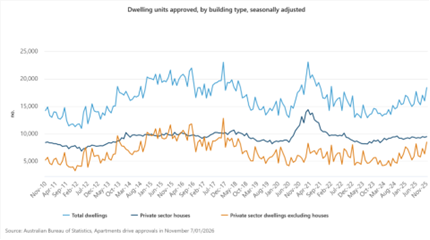
Australia offers an encouraging signal — 193,299 homes were approved in the year to November, a three-year high and 20,000 more than last year.
November was particularly strong, with total approvals up 15.2% to 18,406, led by a 34.1% rebound in higher-density projects, while house approvals rose 1.3% to 9,458.
Australia is not starting from a position of no activity. Instead, the housing pipeline has demonstrated that approval volumes can recover when conditions support new development.
The Key Question: Why Isn’t Every Approval Becoming a Home?
Building approval is only the first step — it’s permission to build, not a guarantee the home will be started or completed. While approvals in the year to November reached 193,299, completions sit around 175,000 annually. That gap is why a rise in approvals doesn’t instantly mean more housing supply.
In simple terms:
Approvals create the pipeline. Construction delivers the homes. Completions add to supply.
The opportunity now is to make that pipeline move faster.
The Approval Numbers Have Improved Significantly
Australia’s housing approval pipeline has improved to its strongest level in more than three years, with 193,299 homes approved in the 12 months to November — around 20,000 more than the previous year.
In total, more than 271,000 dwellings have been approved since the National Housing Accord began. The focus now shifts to maintaining that momentum and ensuring those approvals keep moving through to construction and completion on the ground.
Higher-Density Development Is Playing an Important Role
Apartment approvals surged 63.6% in November to 5,558 dwellings — 44.8% above the yearly average — with Queensland and Victoria leading the rebound.
It shows higher-density development can respond quickly when conditions allow, which is critical for a balanced housing pipeline.
That creates another important opportunity: maintaining consistency in approvals and ensuring approved projects can move efficiently into construction.
Strong Approval Activity Across Key States
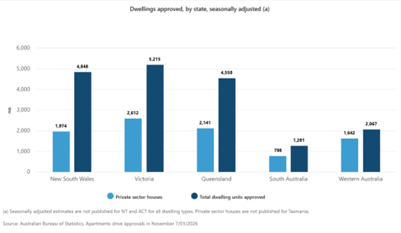
The improvement in dwelling approvals is being supported by strong activity across several states. Victoria recorded 5,215 approvals, followed by NSW with 4,848 and Queensland with 4,558.
The figures highlight that the strengthening housing pipeline is being supported by broad-based approval activity across major markets, providing a positive foundation for future housing supply.
The Real Opportunity: Turning Approvals Into Completions
As noted by the Property Council of Australia, more than 271,000 dwellings have been approved since the National Housing Accord began. The challenge is no longer just getting approvals — it’s keeping a steady pipeline of feasible projects moving forward. The next stage isn’t simply about approving more. It’s about getting approved projects built. That means cutting delays after planning approval, across the steps between approval and completion:-
- Power and water connections
- Utility upgrades
- Subdivision and titling
- Certification
- Other post-permit requirements.
Streamlining these final stages is what will help more approvals translate into actual construction, completions, and supply on the ground.
Conclusion: The Opportunity Is in Delivery
The positive takeaway is clear:
Australia has an expanding pipeline. The next opportunity is to make that pipeline work harder.
- More approvals are a step forward.
- More completed homes are the goal.
And the stronger the connection between those two stages, the greater Australia’s capacity to build the housing supply needed for the years ahead.
Disclaimer: The information presented above is for illustration and discussion only. Any party seeking to rely on the content or otherwise should conduct its due diligence and inquiries to ensure that it is relevant to its personal and business needs and circumstances.