


Australia’s Housing Challenge Is No Longer Just About Affordability
Australia’s property market continues to face a significant imbalance between housing demand and housing supply. While the Federal Government has expanded support for first-home buyers through its First Home Guarantee Scheme, population growth is outpacing new housing delivery.
Australia’s population increased by more than 525,000 people in the year to September 2025, creating substantial demand for both owner-occupied housing and rental accommodation. At the same time, housing construction has struggled to keep pace, contributing to ongoing affordability pressures and low vacancy rates across many parts of the country.
The result is a housing market where demand continues to outpace supply — a trend investors should pay close attention to.
Government Expands First-Home Buyer Support
In an effort to improve access to home ownership, the Federal Government expanded the First Home Guarantee Scheme and removed annual caps from 1 October 2025.
The scheme allows eligible buyers to purchase a property with as little as a 5% deposit while avoiding the cost of Lenders Mortgage Insurance (LMI), reducing one of the major barriers to entering the property market.
The impact has been immediate.
Recent lending data showed new first-home buyer loans increased by 6.8% during the December 2025 quarter, reaching 31,783 loans. Meanwhile, more than 46,000 Australian households used the Home Guarantee Scheme during the 2024-25 financial year.
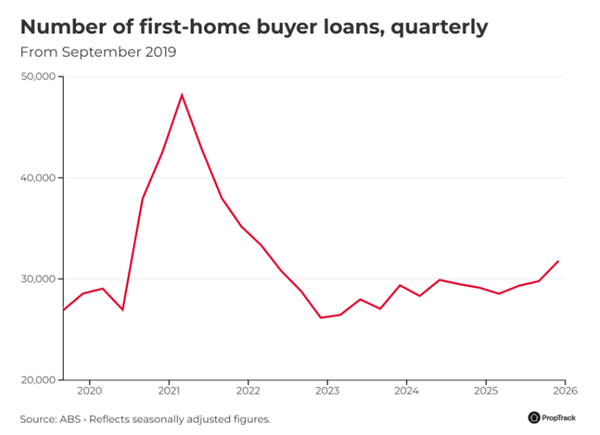
These figures demonstrate strong demand from aspiring homeowners who are eager to enter the market despite affordability challenges.
Demand Is Rising Faster Than Supply
While government incentives help more buyers secure finance, they do not create additional housing stock.
Industry experts continue to highlight that Australia’s housing shortage remains the primary challenge facing the market.
The Federal Government has set an ambitious target of delivering 1.2 million new homes over five years, but industry forecasts suggest housing completions may fall well short of this goal due to labour shortages, planning delays, infrastructure constraints and rising construction costs.
As the population growth continues to outpace housing delivery, competition for existing homes remains intense.
Growth Corridors Continue To Benefit
As affordability becomes increasingly important, buyers are looking beyond traditional inner-city markets and towards emerging growth corridors.
Regions across South East Queensland, Western Sydney, Greater Melbourne, the Hunter Region and parts of regional Australia continue to attract significant buyer interest due to their relative affordability, improving infrastructure and strong population growth.
Many of these areas are experiencing substantial government and private-sector investment, including new transport links, healthcare facilities, education precincts and employment hubs.
For owner-occupiers, these locations provide an opportunity to secure housing at more affordable price points.
For investors, they offer exposure to some of Australia’s strongest long-term growth drivers.
Rental Demand Remains Elevated
The housing shortage is not only affecting buyers.
Australia’s rental market remains under significant pressure, with many regions recording historically low vacancy rates.
As population growth increases and housing supply remains constrained, demand for rental accommodation continues to rise.
Many prospective buyers are also delaying home ownership due to affordability challenges, further increasing pressure on rental markets.
This environment has helped support rental growth across numerous capital cities and regional growth centres, creating opportunities for investors seeking both rental income and long-term capital growth.
What This Means For Investors
Property markets are ultimately driven by supply and demand.
While government incentives may assist first-home buyers, the broader story remains Australia’s ongoing housing shortage.
A population increase of more than 525,000 people in a single year represents a substantial increase in housing demand. Unless housing construction accelerates significantly, this demand is likely to continue supporting both property values and rental markets.
- Investors who focus on locations with:
- Strong population growth
- Major infrastructure investment
- Expanding employment opportunities
- Limited housing supply
- Low vacancy rates
may be well positioned to benefit from these long-term market fundamentals.
Success Avenue Insight
Government schemes can help more Australians enter the housing market, but they do not solve the underlying issue of housing undersupply.
The real story for investors is the growing gap between population growth and housing delivery.
With Australia’s population continuing to expand, housing supply struggling to keep pace and rental demand remaining strong, the fundamental drivers supporting quality property investment opportunities remain firmly in place.
More than 525,000 new residents were added to Australia’s population in a single year, while housing supply continues to lag behind demand. Until construction catches up, well-located growth corridors are likely to remain some of the strongest-performing markets for both capital growth and rental demand.